
 Keyword Research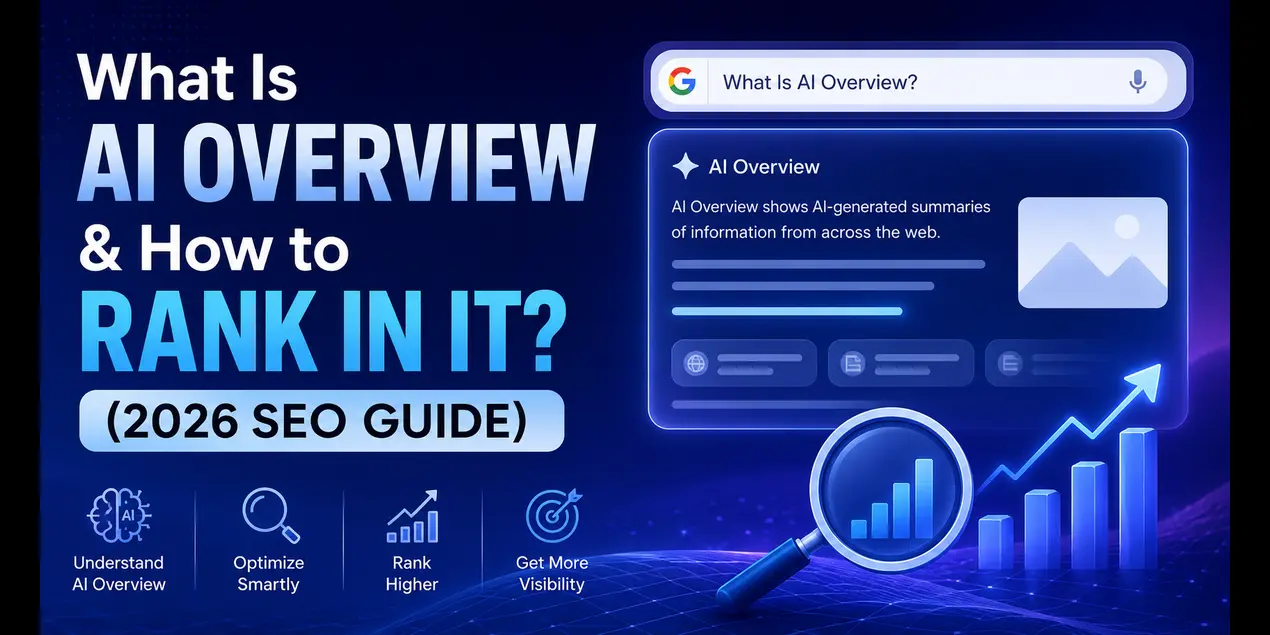
What Is AI Overview?
AI Overview is a feature within Google Search that generates a concise, conversational answer to a query made by a user by using AI and then displays it above standard "blue link" results. Instead of forcing users to go through a variety of websites to find an answer Google's AI examines a variety of pages that rank high and extracts the most important information, and then presents it as a single summary. It usually has three to five sources with 3 to 5 source links.
This is the evolution of what was previously known as SGE (Search Generative Experience) which Google experimented with and later integrated into its main search experience, known as AI Overview.
AI Overview: Key features of AI Overview:
- It appears directly above organic results, and often before any advertisements
- Real-time generated by combining live web data
- Cites multiple sources (usually three to five) with clickable hyperlinks
- Written in a conversational, natural tone, rather than an exhaustive list of keywords
- Include pictures, comparison points, and short bullet-point summaries
- This is more frequently the case in informational queries than navigational or transactional queries.
If you've ever searched for something similar to "best time to post on Instagram" or "how does compound interest work" recently, you've probably have seen an AI Overview box before you came across a normal search result.
How Does Google AI Overview Work?
Understanding the mechanics of typing helps you determine how to optimize your performance for it. What happens in the background when someone type an inquiry:
- The user makes an inquiry
- Google's AI model determines the query's intention (informational, comparative or how-to.)
- It analyses and scans the top-ranked pages with high authority associated with that query
- It integrates the information on many pages into a single coherent answer
- It selects a few of resources to reference and link to
- The AI-generated answer appears in the upper right corner of the SERP with the source links below or next to it
The most important thing to know is that AI Overview does not produce new information. It alters and rephrases the information it discovers on the internet. That means your content has to be well-structured, well-ranked and trustworthy enough to allow the AI to decide to pull it from in the first place. Before displaying it above organic results. According to Google's official guidance on AI features, the same core SEO ranking systems power both traditional results and AI Overviews.
AI Overview vs Featured Snippet vs Traditional Search Results
Many people confuse AI Overview with the older "Featured Snippet" box. They look the same, but function quite different.
| Feature | Traditional Search Result | Featured Snippet | AI Overview |
|---|---|---|---|
| Source count | Numerous (10+ hyperlinks) | 1 single source | Multiple sources (3-5) |
| Content style | Page title + meta description | A direct excerpt of one page | AI-written summary, personal wording |
| Position | Standard list | Above organic results | Over organic results, and often above ads |
| Click-through impacts | Normal | Reduce clicks a bit | Reduce clicks significantly to individual websites |
| How it's made | Algorithmic ranking | Text matches with text that has been extracted | AI synthesizing multiple pages |
The biggest change is that a Featured Snippet is a short snippet of the exact words you've used and displays them. AI Overview analyzes your ideas and mixes them with different sources, and then rewrites the content in Google's style -this is why having a good ranking doesn't suffice anymore. Your content should be organized in a manner that is straightforward to an AI model to understand comprehend, understand, and believe in.
AI Overview vs AI Mode vs SGE - What's the Difference?
These three terms are used in conjunction, but they're not the same thing.
| Term | What It Actually Is |
|---|---|
| SGE (Search Generative Experience) | Google's initial experimental version of AI-powered searches that was test-driven in Google Labs prior to a wider launch. |
| AI Overview | The finalized, widely-rolled-out version of SGE is now a standard feature of Google Search results. |
| AI Mode | A different, more advanced conversational search experience that allows users can follow-up with questions and receive more detailed multi-turn AI responses similar to chatting with an AI assistant. |
Short version: SGE was the beta test, AI Overview is what the majority of users see in the present and AI Mode is the next-level chat-style search experience. Google is expanding to accommodate users who prefer a deeper level of interaction. To improve SEO optimizing your content to be optimized for AI Overview will also help your content appear on the page in AI Mode, since both depend on the same fundamental quality signals for content.
Why AI Overview Matters for SEO in 2026
AI Overview isn't just a small experiment anymore. It's been one of the most prominent aspects of the results page and it's changing the way people discover (and aren't able to discover) websites.
- AI Overview is now appearing for a significant portion of informational searches - usually the vast majority of "how," "what," and "why" style queries.
- It is not as frequently for transactions (people seeking to purchase something) which means that commercial and service pages are not affected more than informational or blog content.
- Being listed as a source within AI Overview puts your brand's name in front of users, even in the event that they don't click -- this increases brand recognition, even in the "zero-click" environment
- Websites that are frequently mentioned frequently in AI Overview tend to also rank well organically, as the same authority and trust signals are in place.
- The absence of AI Overview optimization means competitors who improve for it will get both the attention and clicks.
For companies this translates to one thing: SEO strategy in 2026 will need to be able to handle both traditional rankings as well as AI-generated answers simultaneously.
How to Rank in Google AI Overview(Step-by-Step Strategy)
This is the question that everyone is asking -- how do you get your website featured in AI Overview? These are strategies that work consistently.
1. Strengthen E-E-A-T (Experience, Expertise, Authority, Trust)
Google's AI systems rely heavily on E-E-A-T signals in order to determine what sources are trusted enough to use.
Google's AI systems lean heavily on E-E-A-T signals to decide which sources are reliable enough to cite. As outlined in Google's guide to optimizing for AI search, the best practices for traditional SEO remain the foundation for succeeding in AI-driven features too.
- Include authentic author names bios, bios, and credentials to every article.
- Provide first-hand experiences where relevant (case studies or original data, screenshots)
- Be mentioned or be linked to by other reliable relevant websites in your field.
- Make sure that your "About Us" and contact information clean and up-to-date.
2. Structure Content for Direct Answers
AI models are trained to give straight, clear answers -not overly vague or promotional writing.
- Answer the question in the first two phrases of each section
- Beware of burying the answer beneath lengthy introductions
- Use simple, plain language instead of jargon-laden phraseology
- Make it appear as if you're responding to the question of a real person and not writing an advertisement
3. Use Question-Based Headings
Match the way that people actually look for information.
- Make H2/H3 headings naturally-related inquiries ("How does X function?" instead of "Working of X")
- Mirror "People Also Ask" style phrase
- Make sure you have one question clear per heading, and one simple answer under
4. Add Schema Markup
Structured data can help AI systems to understand your content more quickly and more precisely.
- Implement FAQ schemas for questions-based sections
- Use HowTo schema for step-by-step content
- Add Author schema and Article to establish credibility signals
- Verify markup using Google's Rich Test
5. Build Topical Authority Through Content Clusters
Google's AI is a trusted source for websites that show extensive coverage of a subject not just one single article.
- Create a pillar page for your topic of choice
- Link to related blog posts (and link back to the pillar)
- Explore a subject from different angles-beginner guides and comparisons, FAQs and case studies
6. Optimize for Featured Snippets First
Since AI Overview frequently draws from pages that are already performing well in snippets of:
- Use concise, clear paragraph responses (40-60 words) right after the key headings
- Use numbered lists to guide step-by-step steps
- Use tables to compare data, like the ones found in this article.
7. Cite Data, Studies, and Original Research
AI models prefer content that is backed by factual information.
- Studies and research that have been based on reliable statistics in the event that they are relevant.
- Include your own original information or case studies if you are able.
- Avoid claims that are vague and without evidence to back it up
8. Keep Content Fresh and Updated
Content that is outdated loses rankings as well as AI Citations.
- Update statistics Examples, screenshots, and statistics frequently
- Refresh publish dates whenever content is actually up-to-date
- Remove or modify sections that do not reflect the latest information
9. Improve Technical SEO Fundamentals
None of this is relevant in the event that Google cannot crawl and comprehend your website properly.
- Speed up page load times and improve Core Web Vitals
- Ensure that all pages are mobile-friendly
- Repair broken links and crawl issues
- Use logical, clean URL structure and internal linking
What Types of Content Perform Best in AI Overview?
Each item of information has the same chance of being noticed. AI Overview tends to favor certain formats since they are simpler for AI Overview to analyze and verify, as well as effectively summarize.
- Definition - style content pages that clearly define "what is X" in the first few lines are likely to be pulled up directly for definitional questions.
- Step-by-step instructions - Sequentially numbered content is simple to AI to transform into a clear, logical process.
- Content that compares - "X vs Y" articles that contain tables are the ideal material for sourcing, as the AI can extract organized data points straight away
- Content that is based on checklists - "top 10," "best ways to," and checklist-style posts are naturally converted into AI-generated bullets summaries
- Explainers that are backed by data - content that contains specific numbers or percentages, or even original research is deemed more citation-worthy than the opinion-based writing.
If you're planning to create new content specifically to be competitive with AI Overview for AI Overview visibility, prioritizing these formats over the more generic narrative-style blog posts will greatly increase your chance of being mentioned.
SEO vs GEO vs AIO - How the Three Fit Together
Many people view SEO, GEO, and AIO as different strategies however, in reality they overlap heavily and build upon each other instead of replacing one another.
| Discipline | Primary Goal | Main Focus Area |
|---|---|---|
| SEO (Search Engine Optimization) | Ranking higher in traditional organic results of search | Keywords Backlinks, keywords technical site health on-page structure |
| GEO (Generative Engine Optimization) | You can be cited via AI-driven response engines such as AI Overview, ChatGPT, and Perplexity | Conversational tone and entity coverage direct answers that can be quotable and source credibility |
| AIO (AI Optimization) | Make sure that content is machine-readable and reliable for AI systems in general | Schema markup, structured data clear formatting, E.E.A-T signals |
The truth is that a website constructed with solid SEO fundamentals written in a GEO-friendly, conversational style, and logically built in accordance with AIO top practices in mind, is the page that is most likely to be successful across all search engines -- traditional ranking, AI Overview, and even outside answer engines such as ChatGPT or Perplexity. Making these a single strategy, instead of three distinct lists, is what can make a difference in 2026.
GEO (Generative Engine Optimization) Best Practices
GEO is the process of optimizing content to be optimized to be optimized for AI-driven answer engines, such as AI Overview, ChatGPT, Perplexity as well as Google AI Mode-instead of just using traditional algorithms for ranking. While SEO is focused on ranking pages, GEO focuses on making your content easier for an AI to comprehend and trust. It also helps to provide quotes.
- Write in a conversational, natural style, not a formal style, full of keywords.
- Concentrate on concepts and entities Not just exact-match keywords (AI models can understand the meaning behind words and concepts, not just words).
- Include clear, quotable and concise statements that answer frequently asked questions.
- Use your own data and sources to establish machine-readable credibility.
- Include related subtopics and related semantic variants of your primary keyword naturally throughout your content.
- Create clear headings for content so that AI systems can quickly extract specific sections.
AIO (AI Optimization) Checklist for 2026
Utilize this checklist to assess whether a page is prepared to be a contender with AI Overview for AI Overview visibility.
| Element | Why It Matters |
|---|---|
| FAQ schema markup | Helps AI extract direct Q and A pairs |
| Clear H2/H3 question-based headings | Finds the natural phrasing of search |
| Direct answer in the first 1-2 sentences | Increases the chance of being quoted. |
| Author bio and credentials | The E-E A-T trust signal is built |
| At least one table of comparison | Value of extraction high for AI summaries |
| Internal links to content that is related | Signs of authority from the top |
| Recent examples and statistics | Maintains the integrity of content and keeps it current. |
| Fast page load speed | Make sure content is properly crawled and indexed |
| Mobile-friendly layout | The majority of searches are conducted on mobile devices. |
Common Mistakes That Keep Websites Out of AI Overview
Even websites with high rankings can be ignored by AI Overview if they make these errors:
- Writing lengthy introductions that are vague before answering the question.
- Keyword stuffing in lieu of natural meaningful language.
- Schema markups that are missing or not complete.
- No author information visible or credentials.
- Inconsistent content that doesn't give the full picture of the subject.
- Inattention to the speed of your mobile and page load.
- Publishing outdated statistics or broken examples without making them up-to-date.
How to Check If Your Website Appears in AI Overview
It is impossible to improve what you don't know about. Here's how to measure the visibility of your AI Overview performance:
- Manually search your targeted terms using Google and note whether you see an AI Overview box appears, and if your site is mentioned in the AI Overview box.
- Utilize the Google Search Console's performance information to identify pages that have high views but fewer clicks (a sign that your page might feed AI Overview without getting the click).
- Utilize third-party SEO tools to currently track AI Overview appearances specifically, along with traditional keyword rankings.
- Create a simple tracking sheet with your most important keywords, and then check every month whether AI Overview appears and cites your website.
Real Results - How Businesses Are Ranking in AI Overview
Companies that structure their content around clear answer and strong E-E-A T signals and clean schema markups consistently get better results in organic rankings as well as AI Overview citations, compared to those that rely solely on traditional content that is geared towards keywords. The reason is quite simple: the exact structural changes that aid a page to win a featured short snippet also make it more likely to get incorporated into an AI Overview summary.
At SEODixit our SEO strategies for content and technical SEO are based on this change that combines traditional on-page SEO practices with GEO and best practices for AIO, ensuring that your website will perform well across traditional results in search and the more recent AI-driven search results.
Get in touch
We're here to help! Reach out to us for expert guidance, personalized SEO solutions, or any questions you have.
faqs
FAQs About Google AI Overview
AI Overview is a feature in Google Search that uses AI to produce a consolidated response to a query using information from multiple top-ranked websites and displaying it above regular results for search, with links to the sources.
A featured snippet of text pulls an exact excerpt from a single webpage and AI Overview creates a fresh written summary of AI using data taken from a variety of sources at once and then links several sources together.
It can be particularly useful for informational questions that are simple, where users receive their answer right through the AI Overview box without needing to click any further. However, being mentioned as a reliable source can still result in significant brand exposure and clicks from those who need more information.
Yes. AI Overview citation depends more on the quality of content, its clarity and trust signals such as E-E A-T, rather than domain size or authority on its own. This means that well-structured, truly valuable content on smaller websites could certainly be mentioned.
There's no set timeframe as it is contingent on the speed at which Google's AI systems evaluate and index the new content you've added as well as your site's current authority. Many companies begin to see changes in a matter of weeks to two months after adopting organized, answer-first content as well as schema markup.
Because ranking on AI Overview is still a relatively new field It is important to understand what a realistic timeline will look like when you begin implementing these changes.
- Weeks 1 and 2: Technical fixes and schema markup implementation across all priority pages
- Weeks 3 - 6: Content restructuring -Rewriting intros to provide direct answers including FAQ sections, creating tables of comparison
- Weeks 6-10: Google begins recrawling and reindexing pages that have been updated and early activity in featured snippets as well as "People Also Ask" boxes typically appear first.
- Months 3-4: AI Overview citations generally begin appearing for well-optimized, low-competition informational queries.
- Months 4-6 and above: Broader visibility across more relevant queries, as long as consistent updates to content and authority-building continues
Final Thoughts
AI Overview isn't going anywhere It's becoming a permanent and central element of the way people search. Being able to compete in it requires an adjustment in perspective moving from writing in order to be ranked and then writing that is acknowledged and trusted by AI systems. Combining strong web-based SEO foundations together with GEO and AIO best practices -- straight answers, a clean structure, real knowledge and technical performanceyour site will be positioned to benefit from both traditional search results as well as the AI-driven experiences that will be shaping 2026 and the years to come.
Do you want to conduct a site audit to determine exactly where your content is in terms of AI Overview readiness? Contact SEODixit to schedule a no-cost SEO consultation.